
Why Most AI Programs Fail Before the First Model Is Deployed
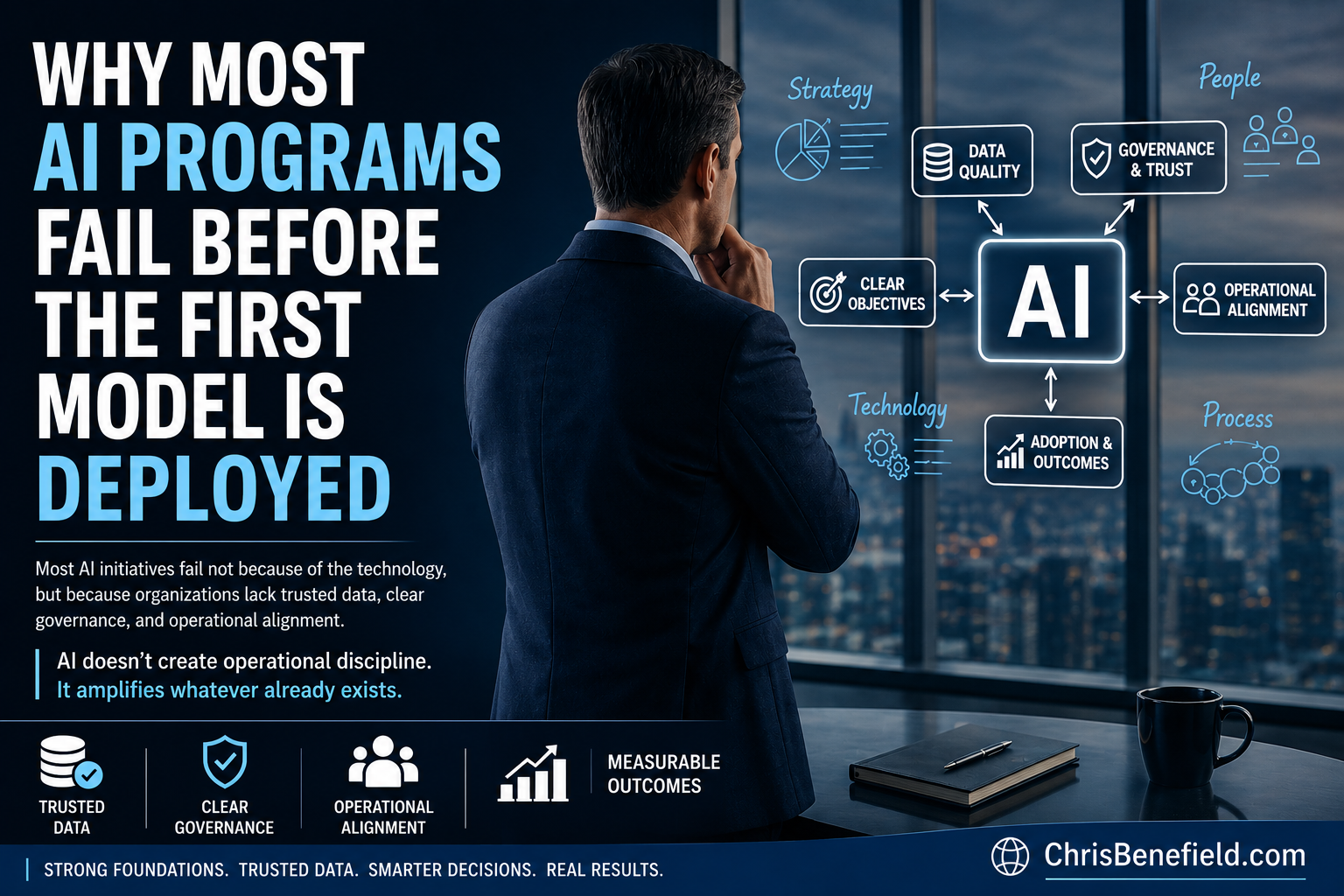
Artificial intelligence is no longer a futuristic concept. It is rapidly becoming a core component of how organizations operate, make decisions, and compete. From predictive analytics and automation to generative AI and intelligent agents, companies are investing heavily in AI initiatives with the expectation of transforming their business.
Yet despite the excitement, many AI programs fail long before the first model is ever deployed.
The common assumption is that these failures are caused by technology limitations, lack of computing power, or inadequate algorithms. In my experience, the reality is far different.
Most organizations do not have an AI problem.
They have a data, governance, and decision-making problem.
“Most organizations don’t fail at AI because they lack technology. They fail because they haven’t built the trust, governance, and operational discipline required to turn intelligence into action.”
– Christopher Benefield
The Real Challenge Isn’t AI
Over the past two decades, I have led analytics, technology, and transformation initiatives across healthcare, retail, and government organizations. During that time, I have seen countless investments in dashboards, data warehouses, predictive models, and advanced analytics programs.
Some delivered tremendous value.
Others never gained traction despite significant investment.
The difference rarely came down to technology.
Successful organizations understood that artificial intelligence is only as effective as the foundation supporting it.
AI amplifies existing conditions. If data quality is poor, AI accelerates poor outcomes. If governance is weak, AI increases confusion. If business processes are broken, AI scales inefficiency.
Organizations often focus on selecting the right tools while overlooking the more important question:
Can we trust the data that will power those tools?
Without trusted data, even the most advanced AI solution becomes little more than an expensive experiment.
The Single Source of Truth Problem
One of the most common obstacles I encounter is the absence of a true single source of truth.
Different departments frequently maintain their own reports, metrics, and definitions. Finance may report one number. Operations may report another. Leadership may have an entirely different version.
When that happens, teams spend more time debating numbers than solving problems.
Artificial intelligence cannot resolve conflicting definitions of success.
Before organizations begin implementing machine learning models or deploying AI agents, they must establish clear governance, standardized metrics, and common business definitions.
The organizations achieving the greatest success with AI are often the ones that spent years building strong data foundations before ever training a model.
A Dashboard Is Not an Outcome
Another mistake organizations make is confusing insights with results.
A dashboard is not an outcome.
A predictive model is not an outcome.
An AI-generated recommendation is not an outcome.
An outcome occurs when information changes behavior and drives action.
Throughout my career, I have seen organizations produce sophisticated analytics that generated little business value because the insights never became part of operational workflows.
The analysis was correct.
The recommendations were sound.
The technology worked.
But nothing changed.
Successful AI programs are designed around decision-making, not reporting. The goal is not simply to create intelligence. The goal is to integrate intelligence into the daily processes that drive business performance.
When AI becomes embedded into how decisions are made, organizations begin realizing measurable value.
Governance Is a Competitive Advantage
Governance is often viewed as a necessary administrative function.
In reality, it is one of the most important enablers of successful AI adoption.
As organizations increasingly rely on artificial intelligence, questions inevitably arise:
- Where did this data originate?
- Can the results be explained?
- How accurate is the model?
- Who owns the process?
- What happens when the recommendation is wrong?
Organizations that address these questions early move faster and with greater confidence.
Organizations that ignore governance often find themselves rebuilding trust after avoidable failures.
Strong governance provides the foundation for:
- Trusted data
- Consistent metrics
- Reliable models
- Regulatory compliance
- Executive confidence
- Scalable AI adoption
In many ways, governance is not a barrier to innovation.
It is what makes innovation sustainable.
Lessons from Mission-Focused Environments
Early in my career, I served as a Department of Defense civilian employee with Camp Lejeune Installation Safety & Security and was selected to serve on the Headquarters Marine Corps Multidisciplinary Safety Inspection Team.
That experience taught me a lesson that remains relevant today.
Information quality matters.
Mission success often depends on leaders making decisions quickly, with limited time and incomplete information. The quality of those decisions is directly tied to the quality of the information available.
Whether evaluating operational readiness, organizational performance, patient outcomes, or financial results, the principle remains the same:
Bad information creates bad decisions. Trusted information creates better decisions.
Artificial intelligence has the potential to dramatically improve decision-making, but only when supported by reliable data, disciplined governance, and clear accountability.
The Future of AI Leadership
The next generation of AI leaders will not be defined solely by their technical expertise.
They will be defined by their ability to connect technology to business outcomes.
Successful leaders will focus on:
- Building trusted data foundations
- Establishing governance frameworks
- Creating operational alignment
- Enabling data-driven decision-making
- Integrating AI into business processes
- Delivering measurable outcomes
Artificial intelligence is not simply a technology initiative.
It is an organizational transformation initiative.
The companies that recognize this distinction will create lasting competitive advantages. Those that focus solely on technology will continue to struggle despite significant investment.
Final Thoughts
Artificial intelligence represents one of the most significant opportunities organizations have ever had to improve performance, increase efficiency, and make better decisions.
However, technology alone does not create transformation.
People create transformation.
Processes create transformation.
Leadership creates transformation.
AI simply accelerates what is already there.
Organizations that build strong foundations, establish trust in their data, and focus relentlessly on operational outcomes will be the ones that realize the full potential of artificial intelligence.
The others may never make it past the first model.