
Artificial Intelligence in Healthcare: Transforming Data into Better Patient Outcomes
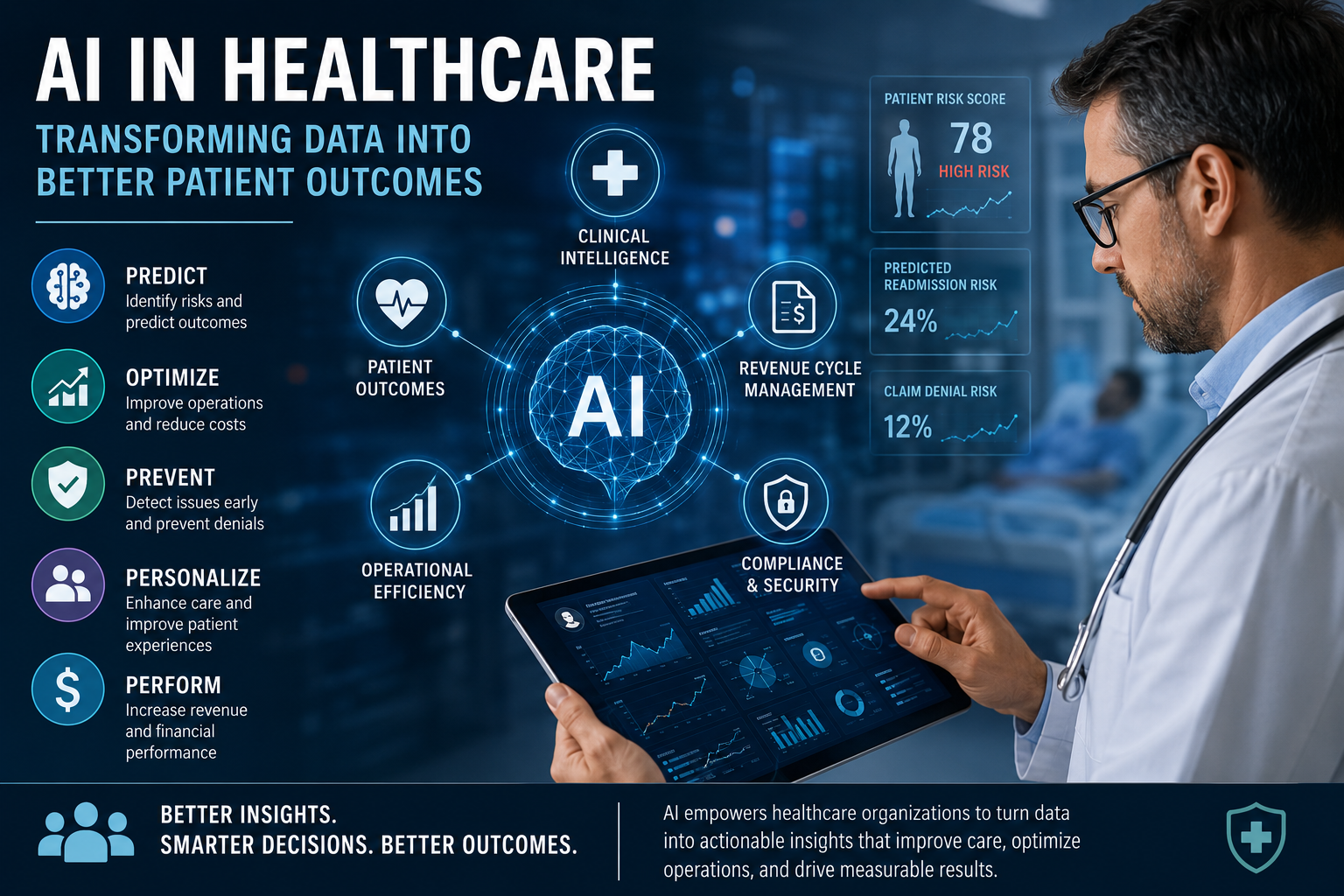
Artificial Intelligence (AI) is no longer a futuristic concept reserved for research labs and technology companies. It has become one of the most transformative forces in healthcare, helping organizations improve patient outcomes, reduce operational inefficiencies, and make more informed decisions.
As healthcare organizations continue to generate enormous volumes of clinical, operational, and financial data, AI is emerging as a critical tool for turning that information into actionable insights.
The question is no longer whether AI will impact healthcare.
The question is how quickly organizations can leverage it effectively.
The Growing Challenge of Healthcare Data
Healthcare generates vast amounts of information every day.
Electronic Health Records (EHRs), medical imaging systems, laboratory results, insurance claims, revenue cycle data, patient engagement platforms, wearable devices, and countless other systems continuously create data.
While organizations have become increasingly effective at collecting data, many still struggle to extract meaningful value from it.
The challenge is not access to information.
The challenge is identifying patterns, predicting outcomes, and making informed decisions quickly enough to create meaningful business and clinical impact.
This is where artificial intelligence excels.
“Artificial intelligence is not replacing healthcare professionals, it is empowering them to make better decisions, improve outcomes, and focus on what matters most: patient care.”
— Christopher Benefield
AI Beyond Chatbots
When most people hear the term “AI,” they often think of chatbots or virtual assistants.
While these technologies are certainly important, AI’s impact on healthcare extends far beyond conversational tools.
Artificial intelligence is being used to:
- Predict patient readmissions
- Identify high-risk patients
- Detect fraud and abuse
- Optimize staffing levels
- Improve revenue cycle performance
- Enhance claims management
- Accelerate prior authorizations
- Support clinical decision-making
- Forecast financial performance
- Identify operational inefficiencies
In many cases, AI can identify patterns and opportunities that would be nearly impossible for humans to discover manually.
AI and Revenue Cycle Management
One of the most promising applications of AI is within Revenue Cycle Management (RCM).
Healthcare organizations lose billions of dollars annually due to claim denials, coding errors, reimbursement delays, and operational inefficiencies.
Traditional reporting often tells leaders what happened after the fact.
Artificial intelligence enables organizations to predict what is likely to happen before financial losses occur.
Imagine a system that can:
- Predict which claims are most likely to be denied
- Identify emerging payer behavior trends
- Detect coding inconsistencies
- Forecast cash collections
- Prioritize high-value reimbursement opportunities
- Recommend corrective actions before claims are submitted
Rather than reacting to problems, organizations can proactively prevent them.
This shift from reactive reporting to predictive intelligence represents one of the most significant advancements in healthcare analytics.
The Rise of Predictive Analytics
Historically, most healthcare reporting has focused on descriptive analytics.
Descriptive analytics answers questions such as:
- What happened?
- How many claims were denied?
- What were collections last month?
Predictive analytics takes the next step.
It answers:
- What is likely to happen next?
- Which patients are at risk?
- Which claims may be denied?
- What will cash collections look like next quarter?
This ability to anticipate future outcomes allows healthcare leaders to make smarter decisions and allocate resources more effectively.
Improving Patient Outcomes
While financial and operational improvements often receive significant attention, AI’s greatest potential may be its impact on patient care.
Healthcare providers are increasingly using artificial intelligence to:
- Detect diseases earlier
- Identify patients at risk of complications
- Personalize treatment plans
- Improve care coordination
- Reduce unnecessary hospital readmissions
- Support clinical decision-making
When combined with clinician expertise, AI has the potential to improve both the quality and efficiency of patient care.
The goal is not to replace healthcare professionals.
The goal is to empower them with better information.
Challenges and Considerations
Despite its potential, AI is not a magic solution.
Successful AI initiatives require:
- High-quality data
- Strong governance
- Clear business objectives
- Privacy and security controls
- Organizational alignment
- Executive sponsorship
Poor data quality will produce poor results, regardless of how sophisticated the technology may be.
Organizations must also ensure that AI systems remain transparent, explainable, and compliant with regulatory requirements.
Trust remains essential in healthcare.
The Future of Healthcare AI
The next generation of healthcare organizations will increasingly rely on AI-powered intelligence to support clinical, operational, and financial decision-making.
We are moving toward a future where healthcare leaders can:
- Predict operational bottlenecks before they occur
- Identify reimbursement risks before claims are submitted
- Forecast financial performance with greater accuracy
- Detect patient care risks earlier
- Automate repetitive administrative processes
- Deliver more personalized patient experiences
Organizations that embrace these capabilities will gain significant advantages in efficiency, financial performance, and patient outcomes.
Final Thoughts
Artificial intelligence is not replacing healthcare professionals.
It is enhancing their ability to make informed decisions.
The most successful healthcare organizations will be those that effectively combine human expertise with data-driven intelligence.
Technology alone does not create value.
The real value comes from transforming data into insight, insight into action, and action into better outcomes for patients, providers, and healthcare organizations alike.
As AI continues to evolve, healthcare leaders have an unprecedented opportunity to improve the way care is delivered, managed, and measured.
The future of healthcare will not be defined by how much data organizations collect.
It will be defined by how effectively they use it.