
From Data to Decisions: Why Executive Dashboards Fail
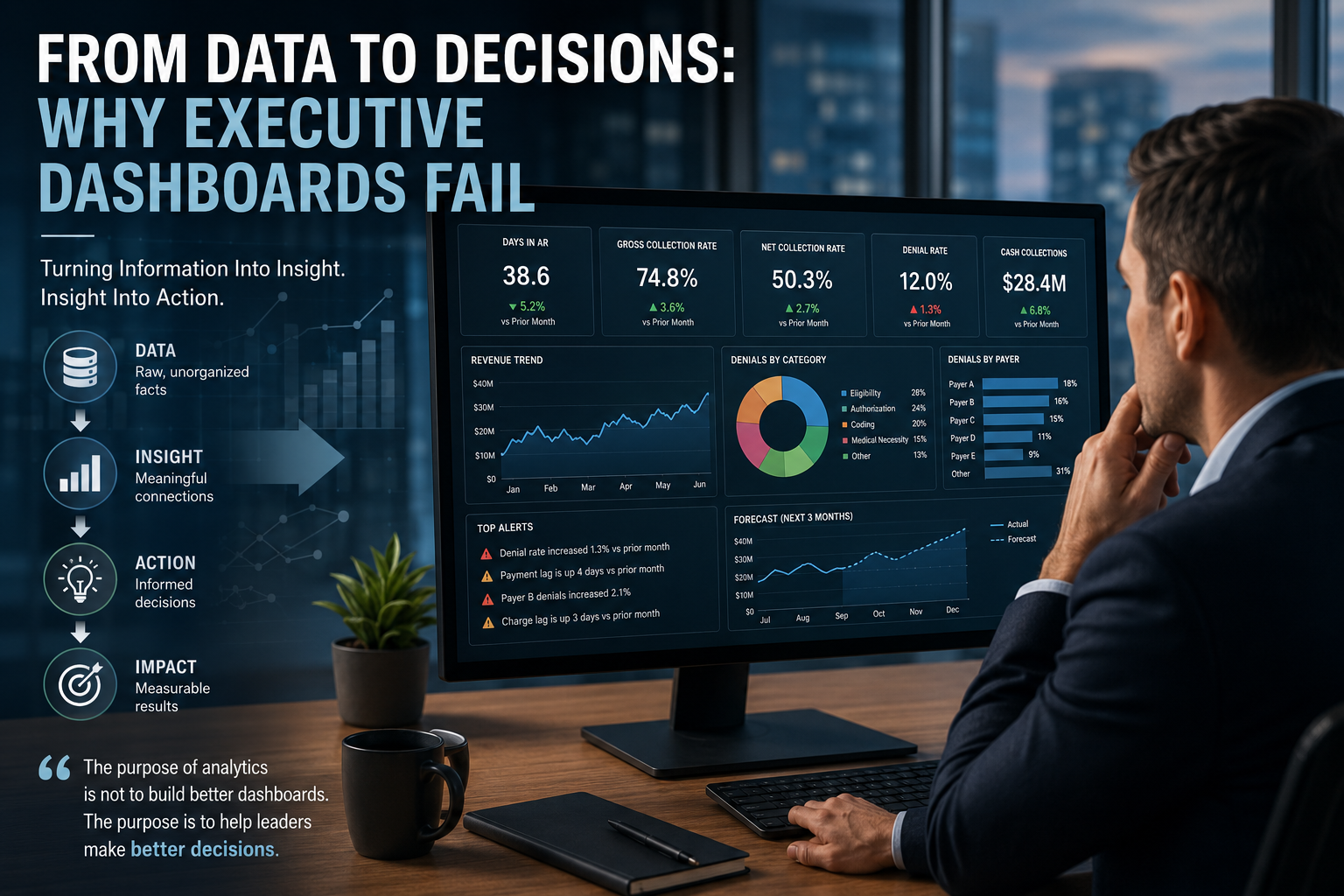
Organizations today have access to more data than ever before. Healthcare providers, revenue cycle teams, and executive leaders receive reports, dashboards, and analytics from dozens of systems daily. Yet despite this abundance of information, many organizations still struggle to make timely, informed decisions.
The problem is rarely a lack of data.
The problem is that most dashboards are designed to display information rather than drive action.
The Dashboard Trap
Many organizations invest significant time and resources building dashboards packed with charts, graphs, and metrics. While visually impressive, these dashboards often overwhelm users with information that lacks context, prioritization, and actionable insights.
Executives do not need hundreds of metrics.
They need answers to critical questions:
- Where are we performing well?
- Where are we underperforming?
- What is causing the issue?
- What action should we take next?
- What is the expected business impact?
A dashboard that cannot answer those questions is simply a reporting tool, not a decision-making platform.
“Executives do not need more metrics. They need clarity, context, and confidence to act.” – Christopher Benefield
Moving Beyond Data Visualization
The most effective executive dashboards focus on outcomes rather than activity. Instead of measuring everything possible, they highlight the metrics that directly influence organizational success.
In healthcare and revenue cycle management, those metrics often include:
- Days in Accounts Receivable (AR)
- Gross Collection Rate (GCR)
- Net Collection Rate (NCR)
- Denial Rate
- Charge Lag
- Payment Lag
- Cash Collections
- Revenue Trends
- Operational Productivity
The goal is not to display more data. The goal is to surface the information that requires executive attention.
Turning Information into Insight
A dashboard becomes valuable when it connects data to action.
For example, a denial rate of 12% may indicate a problem, but executives need additional context:
- Which payers are driving denials?
- Which denial categories are increasing?
- What is the financial impact?
- What actions should operational teams prioritize?
Providing those answers transforms a dashboard from a reporting mechanism into a strategic management tool.
The Future of Executive Analytics
The next evolution of analytics is moving beyond descriptive reporting and into predictive intelligence.
Modern organizations are increasingly leveraging artificial intelligence, machine learning, and predictive analytics to identify issues before they impact operations.
Instead of asking:
“What happened?”
Organizations are beginning to ask:
“What is likely to happen next?”
Predictive analytics enables leaders to identify emerging trends, forecast financial outcomes, prioritize operational improvements, and proactively manage risk.
Final Thoughts
Technology alone does not create value.
The organizations that succeed are those that transform data into insight, insight into action, and action into measurable business outcomes.
The purpose of analytics is not to build better dashboards.
The purpose of analytics is to help leaders make better decisions.
As data volumes continue to grow, organizations that focus on actionable intelligence rather than information overload will gain a significant competitive advantage.